Showing posts with label fiction. Show all posts

Saturday, February 02, 2013

Review: Sir Gawain and the Green Knight by Unknown


I cannot believe this is the first time I have ever read an Arthurian Legend.  Before a few weeks ago, I didn't know this work was part of said canon... me being notorious for not reading reviews.  In August I made a trip to the British Library and paid for a 'special exhibit', where I saw a copy of the Folio Society version of this work and based on the cover and a brief description, I was in love.  When I finally joined The Folio Society in December, I knew this would be the first work that I purchased.

The translation  of the Folio Society publication is by Simon Armitage and since I have no object of comparison, there is not very much I can say about it.  It had a simple flow and was definitely an easy read.  The illustrations by Diana Sudyka were not my cup of tea at all, with the exception of the beautiful cover... of of the most beautiful I have ever owned.  The Folio Society publication was fairly large, measuring 13" by 9 1/4" - I believe it was a little too large to read with on the couch and my roomie thought it was a little humorous.  There was a lot of blank space on most pages, but for those that love the feel of great paper, this was up to the usual thick standard with a creamy ivory colour.

The work itself is about a Green Knight that comes at Christmas to challenge the Knights of King Arthur to a holiday 'game'.  He is completely green, from his clothing to his skin... and even his horse is green.  He challenges anyone to cut of his head with an axe and if he lives, in one year, he gets a chance to cut off the antagonist's head - a sort of 'head for a head' thing.  Why anyone thinks this is a cool party game is beyond me, but King Arthur accepts the challenge when no one else will.  Sir Gawain stands up to the Knight simply to take Arthur's place. 

I won't go into what happens from there, but the tale is all about honour, truth, sins of men and the temptation of men by women (see quote below).  The tale in itself is told quite simply, but has a wonderful message.  While Sir Gawain lives by an honour code, even he can fall off track when encountering certain situations in life and he must constantly remind himself of this to stay on what he believes is a righteous and honourable path. 

I would like to eventually read the translation by J.R.R. Tolkien.  Tolkien was influenced by many of these ancient works including this one and Beowulf which were instrumental in the crafting of his fantastical world. 

I'm glad I read the work in general - it has a good message and I didn't see the plot twist coming, and while it gave me a good preliminary feel for Arthurian legends, it didn't have the impact of some of the other ancient works I have read as of late... such as Gilgamesh & The Song of Roland.

-------------------
QUOTATION:
"'And mind you commend me to your mannerly wife, both to her and the other, those honourable ladies who kidded me so cleverly with their cunning tricks.  But no wonder if a fool should fall for a female and be wiped of his wits by womanly guile - it's the way of the world.  Adam fell for a woman and Solomon for several, and as for Samson, Delilah was his downfall, and afterwards David was bamboozled by Bathsheba and bore the grief. All wrecked and ruined by their wrongs; if only we could love our ladies without believing their lies. And those were fellows from fortunate families, excellent beyond all others existing under heaven,' he cried.  'Yet all were charmed and changed by wily womankind.  I suffered just the same, so clear me of my crime.'"

Review: Song of Roland by Unknown


"The Song of Roland (La Chanson de Roland) is an heroic poem based on the Battle of Roncesvalles in 778, during the reign of Charlemagne. It is the oldest surviving major work of French literature. It exists in various manuscript versions which testify to its enormous and enduring popularity in the 12th to 14th centuries. The oldest of these is the Oxford manuscript which contains a text of some 4,004 lines and is usually dated to the middle of the twelfth century (between 1140 and 1170)."  -Wikipedia

I had never heard of The Song of Roland before my membership with The Folio Society, but I'm glad they introduced me to this work.  This particular edition is translated by Charles Scott Moncrieff and illustrated by Anna and Elena Balbusso.  It's hard for me to comment on the translation, but I found this work incredibly poetic and very easy to read.  The illustrations were hit and miss for me - a very modern take that I don't really think fit the work.  Some of the illustrations, such as the one further down in this review, were quite stunning.  The cover presented is BEAUTIFUL... and I think, very representative of the story and, in this case, the most poignant scene of the poem.

This story is really about a battle between Pagans and Christians, the Christians (Romans) attempting to take over large amounts of territory to pass along Christianity to others with 'inferior' religions.  King Charlemagne is about to wage war with King Marsile (Muslim), but offers treasure and conversion to Christianity if Marsile and the Franks will go back to France.

*START OF MAJOR PLOT SPOILERS*

Roland's stepfather, Ganelon, becomes a traitor in order to get back at Roland for volunteering him to be the messenger of the offer. They betrayal of Roland and the Christian Knights leads to their slaughter.  Roland's pride becomes his downfall when he refuses to blow his horn (olifant) when he sees that he is outnumbered.  He acts on courage and the belief in God - he himself believing that he is fated to die.  After everyone dies, he finally blows his horn... bursting his temples and causing his own martyrdom.  He is met by a saint who takes him to Paradise.
King Charlemange comes to the call to bury the dead and mourn the loss of his nephew.  He is eventually met with a Spanish Muslim contingent which is destroyed.  Ganelon is quartered for his betrayal and those who stood up for him in his trial are subsequently hanged. 

*END OF MAJOR PLOT SPOILERS*

The ending of the work, I believe, is the best part.  King Charlemagne has another dream (the first from God, warned him about the treachery of Ganelon - which he believes is fated and cannot be stopped) that tells him that he must continue to push on to battle with another foe - I suppose to continue to spread the message from God (Christianity).  He is tired, but realizes that man does not choose his own path and he must follow what is presented to him.  This reminds me of my favourite Steinbeck quote, "You don't take a trip, a trip takes you."  I think that if you let yourself be open to things the universe will guide you.  I believe we each have the power of choice, but I believe we are given cues to follow and can choose to do so or not.  King Charlemagne is clearly put all his faith in these cues, which he believes come from God.  Giving up your control to a 'greater power' creates quite a struggle and this struggle is evident with Charlemagne and is captured quite beautifully.

This work was a little too 'rah rah Christianity' for my liking, but is quite fascinating when looking back on the believed cleansing by Christians over 1,200 years ago.  The blood-thirsty revenge seems very un-Christian on the surface, but this gruesome slaughter was seen as justice and not as cleansing... and I suppose the same could be said of Hitler's belief in the genocide, though not based on religious principles. 

The pride of Roland was quite frustrating and proved to be his Achilleus' heel.  This was one example in the poem that showed the characters in the Song of Roland to be quite human... both with strengths and flaws. 

I'm quite glad that I read this work - it has left quite an impression on me.  I think I will eventually do some more research into the beginning sweep of the forces of Christianity.  I know there is a new set from The Folio Society called 'Pagans and Christians' by Robert Fox Lane... and I believe I will keep my eye out for this one.  If anyone has read that work or The Song of Roland, would love to know your thoughts!

Sunday, January 20, 2013

Review: Short-stories by Anton Chekhov


Short-stories are a difficult to review on the whole, even at the best times.  In my case, I have traveled thousands of miles (kilometers) as of late, it has been many months since I read this work, I have read about 10 books since these stories, and I didn't write down any notes!  This 'review' is an impossibility and it had been daunting for me, which is why I left it until last in my reviewing backlog. 

I'm a big fan of the Russians greats, which I think I have documented here quite often: Tolstoy, Dostoevsky, Nabokov, Turgenev, Pasternak, etc.  I was lucky to have picked up a few of Chekhov's stories in Nottingham when I was traveling around; I thought that it would be a great idea to read a few of them on trains or before bed or at other moments where I didn't have very much time to read something seriously.   I had never read any short-stories by Chekhov before, but since he is well known as one of the masters of the short-story, I was excited to plow through them.

I read somewhere that one thing that many people struggle with is Chekhov's particular style in regards to the 'message' located within each story.  I found that the reviews I had read were correct - Chekhov leaves it up to the reader to decide which lessons to glean from most of his stories.  I believe he tells a story to have told it and once it's completed, he moves onto the next not really caring what readers THINK of it.  Chekhov was a physician before he ever became a writer and I could theorize that he just began to write for sheer enjoyment and not with a greater purpose in mind.  I don't pretend to know if I would be right in making this assumption, but it seems to make sense after reading these 24 stories.

I also agree that he seems to embody the Russian way of life (granted, I am fairly ignorant in a very good portion of their history), preferring to focus on common people as opposed to the aristocracy and 'elite' of society.  When I think back upon the stories many months after reading them, I can FEEL various scenes in the stories and I think that's indicative of a good writer.  I will definitely re-read some of these stories in the future and make substantial notes on my feelings about each one, and which ones are my favourites.  I'll now just present a list of which stories were involved in my edition (along with a small amount of quotations), more for my own benefit than anything else.  Would love to hear what you think of Chekhov's short stories or his only novel, The Shooting Party.


1.       Overseasoned

2.       The Night Before Easter

“why is it that even in the presence of great happiness, a man cannot forget his grief?”

“when a man is tired and drowsy he thinks that nature, too, is in the same condition.”

3.       At Home

“No doubt that is one of the laws of society – the less an evil is understood the more bitterly and harshly it is attacked.”

“The more enlightened a man is the more he is given to reflection and hair-splitting; the more undecided he is, the more full of scruples, and the more timidly he approaches a task.”

4.       Champagne

5.       The Malefactor

6.       Murder Will Out

7.       The Trousseau

8.       The Decoration

9.       The Man in a Case

“How many wrong and foolish deeds are committed in our country towns because we are bored!”

10.   Little Jack

11.   Dreams

12.   The Death of an Official

13.   Agatha

14.   The Beggar

15.   Children

16.   The Troublesome Guest

17.   Not Wanted

18.   The Robbers

19.   Lean and Fat

20.   On the Way

21.   The Head Gardener’s Tale

22.   Hush!

23.   Without a Title

24.   In the Ravine

Review: The Scarlet Letter by Nathaniel Hawthorne


The Scarlet Letter is the story of Hester Prynne, a woman that commits adultery and is brandished with a red letter A - as a warning to others of the sin she committed.  She is publicly ridiculed and despite this, refuses to give up the identity of the male culprit.  Pearl, Hester Prynne's daughter, is also a constant reminder to Hester of her sin... and the child is credited with many spiritual qualities, both angelic and demonic.

Hawthorne reminds me of a poor man's Thomas Hardy.  He has thought out the plot, spirituality, an ostracizing from society, redemption, etc of this book very well - the story itself is a marvel.  However, the prose is far from Hardy standards and of course, the work does not have the typical Hardy tragic ending.  However, the carefully woven plot is indicative of Hardy with the exception that it doesn't seem to be as complex a web.  The work is brilliant in it's own right, but feels amateur when compared to some of the other greats of Hawethorne's time.

I enjoyed reading the story of Hester - she was a lovable character that you couldn't help but root for.  The innocence, depth and devilishness of Pearl was written beautifully and it made you love her and feel creeped out by her at the same time.  Her presence lingers on you well after you read about her and I haven't felt this way about a character since nearly a year ago, when I read Jack London's The Sea-Wolf.

My kind of humour
While the conclusion was not quite expected, I found myself predicting much of the plot elements - indicative of a slight formulaic approach to writing.  The story itself is one that will stick with you, and I believe that when coupled with the carefully woven plot, the work is justly considered a classic.  I wouldn't classify it as one of the top 50 of all-time, but I'm glad that I read it... I enjoyed the story and it taught me both positive and negative aspects of writing.

QUOTATIONS:

“An effect – which I believe to be observable, more or less, in every individual who has occupied the position – is, that, while he leans on the mighty arm of the Republic, his own proper strength departs from him.  He loses, in an extent proportioned to the weakness or force of his original nature, the capability of self-support. If he possesses an unusual share of native energy, or the enervating magic of place do not operate too long upon him, his forfeited powers may be redeemable.  The ejected officer – fortunate in the unkindly shove that sends him forth betimes to struggle amid a struggling world – may return to himself, and become all that he has ever been.  But this seldom happens.  He usually keeps his ground just long enough for his own ruin, and is then thrust out, with sinews all unstrung, to totter along the difficult footpath of life as he best may.” 42

“…there has never been, for me, the genial atmosphere which a literary man requires, in order to ripen the best harvest of his mind.  I shall do better amongst other faces; and these familiar ones, it need hardly be said, will do just as well without me.” 49

“There was a remarkable intelligence in his features, as of a person who had so cultivated his mental part that it could not fail to mold the physical to itself, and become manifest by unmistakable tokens.” 65

“’…up to that epoch of my life, I had lived in vain.  The world had been so cheerless!  My heart was a habitation large enough for many guests, but lonely and chill, and without a household fire.  I longed to kindle one! It seemed not so wild a dream – old as I was, and somber as I was, and misshapen as I was – that the simple bliss, which is scattered far and wide, for all mankind to gather up, might yet be mine.  And so, Hester, I drew thee into my heart, into its innermost chamber, and sought to warm thee by the warmth which thy presence made there!’” 81

“Love, whether newly born or aroused from a deathlike slumber, must always create a sunshine, filling the heart so full of radiance that it overflows upon the outward world.” 224

“No man, for any considerable period, can wear one face to himself and another to the multitude, without finally getting bewildered as to which may be the true.” 237

“’Be true! Be true! Be true! Show freely to the world, if not your worst, yet some trait whereby the worst may be inferred!’” 285

“It is a curious subject of observation and inquiry, whether hatred and love be not the same thing at the bottom.  Each, in its utmost development, supposes a high degree of intimacy and heart knowledge; each renders one individual dependent for the food of his affections and spiritual life upon another; each leaves the passionate lover, or the no less passionate hater, forlorn and desolate by the withdrawal of his subject.  Philosophically considered, therefore, the two passions seem essentially the same, except that one happens to be seen in a celestial radiance, and the other in a dusky and lurid glow.” 286

Saturday, January 19, 2013

Review: The Girl with the Dragon Tattoo by Stieg Larsson


I was sitting in my hostel in Brussels  a couple of months ago, and left on the little night table by my bed as a copy of 'The Girl with the Dragon Tattoo' - in the dreaded movie edition cover.  It turned out to be an English copy in a French/Flemish city, so I figured it was a good idea to pick it up and give it a shot despite it being quite different then my usual diet of classics (it ended up with a friend in Croatia, then to Canada).  But, I was on vacation!  So I traveled around quite a bit on the train and read it when I had finished all my expenses and the landscape on the train wasn't very exciting. 

If you're looking for literature, this book isn't what you're after.  It was a decent 'thriller' novel, but nothing really special.  The best part of the book for me was the backdrop of the book - the country of Sweden - which I had passed through a bit earlier on my trip.  As I was reading this work I could not help but see Daniel Craig running around, piecing together clues of the crime and sleeping with quite a few of the characters.  The fact that I had watched the movie and remembered a bit of the plot made it so that I couldn't really give this novel a fair shake.

Art courtesy of
hollytheterrible.deviantart.com

The constant mention of female abuse in the work was a direct result of Larsson's experience watching three of his friends gang-rape a woman (see Wikipedia).  This theme overlaid much of the novel - much more so than I felt in the movie at the time.  There were themes of revenge, redemption, the triumph of good over evil, greed, sexual exploitation and sexual experiences in general (quite a few).

If you like modern day thrillers and aren't squeamish, you'll probably enjoy this work.  Otherwise, I would suggest steering clear of it altogether.  A decent book for what it is, but now that I've tested the hype, I will not read the remaining books.

Review: Typee by Herman Melville


If only physical books themselves could talk.  I encountered Typee while back-packing in Copenhagen in a hippy yoga hostel.  It's customary for backpackers to pick up books here and there and drop them off when completed.  I must have read this work for awhile because I don't remember giving it away until I met a woman from New Zealand (and South Africa), living in London... in southern Italy.  This book traveled to more countries than most people did - and who knows where it ends up after London!

Like typical Melville style, this information is purely tangental.  I should really discuss the story of Typee, briefly... as it's been quite some time since I perused the pages. 

MINOR SPOILERS BEGIN HERE

Typee is the real-life, non-fictional account of Melville's habitation with savages in the Marquesas Islands in Polynesia.  He was on a trading boat, which he felt would NEVER stop it's journey on the seas, so he decided to leave with a fellow sailor (Tom) on an island in the Marquesas during a stop at a friendly French port (the island being partially occupied by the French).  After running out of food while in hiding, they both decided to risk the cannibalistic 'savages'.  After a time, Tom leaves to get help for Melville when he falls ill... but never returns.  At the time of publication of Typee, no one yet knows what happened to Tom... and we only find out from Melville in a follow-up publication.

Marquesas Islands
I won't give away any details about what happens to Melville, but you already know that somehow he lives to tell this story as well as his infamous Moby-Dick.  Melville details many aspects of the Typee, the name for a specific islander tribe, in great detail.  It is a fascinating account of a man that finds himself held captive by cannibals.  Melville is happy, depressed and frightened as he learns more and more about the native tribe and you feel like you are right there with him.  For the most part, he tries to partake in their customs without too much of his own influence... but it is evident that he's not as open to try new things as some would be - but I can't blame him for not having his face tattooed! 

END OF MINOR SPOILERS

While not the epic work of literature that Moby-Dick was, I enjoyed this work more for its simple pleasures.  The prose was simple and to the point, the detail was very strong at times but did not feel heavy-handed and you really felt the characters come alive.  All in all, a very good first work by Melville, in my opinion. 

Review: Moby-Dick by Herman Melville


As it seems to be with well-accepted classic epics of literature, I felt guilty for not having read about Moby Dick, the white whale. My first foray into Melville began a couple of months ago when I delved into his initial work, Typee (to be reviewed later). I expected a very similar style from Melville with Moby-Dick, but was astounded by the differences in technique.  Typee was a good story with a simple re-telling of the facts, unencumbered by allusions but heavy with tangental information pertaining to the tribes of the Marquesas Islands.  Moby-Dick was tangental to the extreme.  There was one chapter dealing with objects that are the colour white, like the whale.  There were three chapters detailing certain paintings that Melville liked and disliked about whales.  All this is mixed up with the actual story of Captain Ahab's obsessive search for the mammal.   I found that, while the tangents were welcome in Typee, they were at times counter productive in Moby-Dick.  The obsessive detail over small points in the story, coupled with the lack of detail on what I considered to be more important to the character development or understanding of the inner workings of the ship, the Pequod, was shocking. 
 
The allusions in the work were in the hundreds, and I made quite a concerted effort to read most of them.  Many allusions did not stand up over the course of time and seemed superfluous.  Others showed the tremendous intelligence and bookish obsessiveness of Melville, and these allusions were a delight to me in many cases.  All this said, there are many that will disagree with this statement, but I believe Melville's editor dropped the ball on this work.  The work could have been a hundred pages shorter easily without stripping away character development or key aspects of the story.  In addition, I still feel that more time should have been spent in discussing how the boats were brought out to the whale and other hinted at but misunderstood components of whaling.
 
The initial scenes with Queequeg in the inn, the description of the impending death of Queequeg, the obsessions and ramifications of the obsessions of Ahab, all actions and interactions between Ahab and Parsee (the clairvoyant) as well as some great sea epiphanies by Ishmael... all these points were absolute marvels.  Melville was on the top of his game here and it was so beautiful and enthralling to read. 
 
Illustration by Rockwell Kent
There were some drawbacks other than what I previously mentioned.  I believe Melville continued to further the damage caused by whaling by making assumptions about their resiliency despite the continual whaling: “…we account the whale immortal in his species, however perishable in his individuality.” 381.  This is a true disservice and is one of the results of a desire to express opinions on subjects Melville himself knew nothing about.  It was quite evident that Melville knew nothing about the migratory patterns of whales - he simply states that they have a 'large playground'.  He states that whales can go hide in the arctic where people cannot follow them, not knowing the seasonality of such migrations... and the eventual ability of man to fish these waters.
 
Melville did not detail how many whales were in the ocean to determine if they were over fished.  He assumed that they weren't and that was that.  Granted, at the time whales were not being killed at the rates that eventually constituted the peak of the whaling industry, but if anything... Melville did not do the whales any justice by claiming that the species was immortal.  He had no idea about the long gestation periods of whales or their low reproductive rates.  He assumed incorrectly that more whales would take the place of the ones killed.  While most were ignorant about whales in those days, Melville did not need to make such bold statements backed without evidence... and I found this to be an extremely perturbing flaw in this work.  Melville's continual attack on bad research in regards to the authors of literature and illustrations of whales, I find laughable given his own statements presented as facts with little or no evidence.
 
All this said, Moby-Dick had some flashes of brilliance and I was glad to have experienced it.  It wasn't a page turner, it could have used better editing and less assumptions, but the humanity in the work was dripping, the spirituality of the quest and impending doom was haunting and tantalizing and I found that I enjoyed learning about the nuances of the characters.  A very solid work of literature, but in my opinion... falling short of the hype.
 
QUOTATIONS:

“But all the things that God would have us do are hard for us to do – remember that… And if we obey God, we must disobey ourselves; and it is this disobeying ourselves, wherein the hardness of obeying God consists.” 37

“You cannot hide the soul.” 43

“I have no objection to any person’s religion, be it what it may, so long as that person does not kill or insult any other person, because that other person don’t believe it also.  But when a man’s religion becomes really frantic; when it is a positive torment to him; and, in fine, makes this earth of ours an uncomfortable inn to lodge in; then I think it high time to take that individual aside and argue the point with him.” 73

“There are certain queer times and occasions in this strange mixed affair we call life when a man takes this whole universe for a vast practical joke, though the wit thereof he but dimly discerns, and more than suspects that the joke is at nobody’s expense but his own.” 189

“…man is a money-making animal, which propensity too often interferes with his benevolence.” 342

“…we account the whale immortal in his species, however perishable in his individuality.” 381

“…the Parsee’s mystic watch was without intermission as his own; yet these two never seemed to speak – one man to the other – unless at long intervals some passing unmomentous matter made it necessary.  Though such a potent spell seemed secretly to join the twain; openly, and to the awe-struck crew, they seemed pole-like asunder.  If by day they chanced to speak one word; by night, dumb men were both, so far as concerned the slightest verbal interchange.  At times, for longest in his scuttle, the Parsee by the main-mast; but still fixedly gazing upon each other; as if the Parsee Ahab saw his forethrown shadow, in Ahab the Parsee his abandoned substance.” 438

“…Ahab never thinks; he only feels, feels, feel;, that’s tingling enough for mortal man! To think’s audacity.  God only has that right and privilege.  Thinking is, or ought to be, a coolness and a calmness; and our poor hearts throb, and our poor brains beat too much for that.” 460

Review: Epic of Gilgamesh


I want to apologize for the hiatus from the blog for the last six months or so.  I haven't mentioned this on the site, but in July I went traveling around Europe for nearly six months.  Over 20 countries later, I'm back in Canada... at least for now.

I managed to read a decent amount despite my globetrotting.  I'll try to write up some quick accounts of the books, but to be honest, there has been a lot in my mind that books have had to compete with.  I've had some dedicated time with two books this month, so I'll start out by reviewing them both.

I have been thinking a lot about re-focusing my reading.  I feel as if there are some glaring holes in my reading background - namely ancient epic works and the Bible.  I don't want to delve into religion here, but I do want to read as much of the Bible as possible in order to understand some references that I feel have been going over my head when reading the classics. 

The Epic of Gilgamesh is an epic poem, written around the 18th century BC, and is one of the first known works of literature/poetry in the world.  It was written on clay tablets - the central epic story being contained on 12 of them, with other tablets found in different areas of the world used to fill in gaps on the main tablets (due to illegibility).  The Folio Society edition, translated by Andrew George, contains a "standard version" of the Epic which is entitled "He Who Saw the Deep" which is supplemented from material found in other fragments of the other tablets found.  In addition, these supplementary tablets are contained in their translated entirety - adding about double the Gilgamesh of other translations.  I would caution, based solely on one perusal of Wikipedia, as being cautious about the Stephen Mitchel translation: "Stephen Mitchell in 2004 supplied a controversial translation that takes many liberties with the text and includes modernized allusions and commentary relating to the Iraq war of 2003."  I haven't done any further research into this, but I was glad to be reading a seemingly superb translation by Andrew George.

Illustration by Francis Mosley
The Epic of Gilgamesh is a work that must be read - period.  It shows you where many stories from the Bible probably come from, including the great flood and the story of Adam and Eve.  There are many small references, including fairly evocative snake shenanigans (sound familiar?)!  In addition, the concepts of the heavens and the underworld coupled with many different Gods, shows the influence Mesopotamia had on Greek culture... eventually giving rise to such greats as Homer.  In addition, the work has the ability to put present day life into context.  Gilgamesh's struggles with mourning, mortality, female relations, friendship, etc... all serve to put into perspective our own struggles.  There are many current hardships that we face, that have been a constant with humanity for over four thousand years; there is evidence of this contained in Gilgamesh and there comfort in this, somehow.

What surprised me, is that ignoring the religious, cultural and humanity significances... this epic is also a great story.  I did not ever want to put it down.  Many ancient texts seemingly lack readability and my assumption was that this work would be the worst of the lot, but this could not be further from the truth.  Despite the fact that there are still many holes in the work due to illegible tablets, the story flowed beautifully.  Note that you will have to get used to the style by which the epic is presented.  In my translation, there are quite a few repeats of information... but if you have a shady memory like my own, it will serve to solidify the text.  Those of you who have read Homer will see parallels in this repeating method of storytelling.

I'm not going to include any spoilers in this review.  I suggest that if anything in this post intrigues you, go pick up a good translation of this work and give it a go one afternoon.  It's less than 100 pages and I think you'll be as impressed as I was - especially if you are a fan of the Ancient Greeks or appreciate the stories of the Bible at any level.

Sunday, June 10, 2012

Review: Purgatory by Dante Alighieri

Reading The Divine Comedy has been a humbling experience.  The novel has so many layers and references within it, I feel as though there are many passing me by.  My initial feeling on the best way to get the most out of Dante is to first read all the Greek works and then read the Bible and if possible, a bit about the history of Italy around the time period of publication.  The references and allusions would become deeper in meaning and the text would be more enjoyable.

After reading Melville Best Anderson's translation in my Easton Press edition (100 Greatest Books Ever Written), I felt like the translation was weighing me down.  I could not read more than a few canto's at a time - they seemed to be thick... kind of like walking in Atreus's Swamp of Sorrows in The Neverending Story.  In addition, the illustrations by William Blake were of a muddled quality, due to the printing of the edition.  It all seemed to add to the overwhelming feeling that I needed to try a new edition.

Dante is carried away to Purgatory
[Illustration by Gustave Dore]
As luck would have it, I found a copy made by the Franklin Library (part of the 100 Greatest Books of All-Time series).  The Franklin Library books were made by the Franklin Mint before their publishing arm went out of business.  What I really enjoyed about this edition was the translation.  John Ciardi has done an excellent job of making the text more readable and fluid, without losing the important details.  In addition, I now have chapter summaries preceding each Canto which gives you background detail on the allusions/references - which I previously stumbled through (checking wikipedia at every turn for further information).  These analytical chapter summaries have proved invaluable.  And just how the illustrations by Blake seemed to match the muddiness of the Easton Press' translation, Gustave Dore's illustrations seemed to match the fluidity of the Ciardi translation.  The translation and illustrations are so good, that I'm actually dreading moving on to the third edition - it's quite possible that I revert back to Ciardi/Dore at some point.
And now on to the work itself.  Dante has just left Hell and is being carried away to Purgatory.  Purgatory is a place where souls purge themselves of their sins - consequently, there are seven terraces on the mountain in Purgatory - to match the seven deadly sins. We are shown souls atoning for their sins on every terrace, one for lust, gluttony, greed, sloth, wrath, envy and pride.  I wonder if the reader's thoughts affect which stories stick in the mind the most.  For me, I have an overwhelming picture of the emaciated souls repaying their sins of gluttony and the souls whirling around at a high pace and never stopping - repenting for their sins of sloth. 

My favourite part of this work is Dante breaking down before Beatrice and atoning for his own sins.  Beatrice was a woman that had such effect on Dante, he ended up immortalizing her in his work - despite only meeting the woman twice in a nine year span... before her death at the age of 24.  What I enjoyed most about his repentance is that he does not specify what he is repenting for - and I took it as the author respecting his own privacy in his work and showing that each of us has our own personal sins which we atone for in our own private ways.  It was very beautiful to me.
Matilda guides Dante in cleansing in the river Lethe
[Illustration by Gustave Dore]
The imagery in the work was made even stronger by Gustave Dore's illustrations - I felt incredibly moved when reading the scene where Dante is dipped in the pure river Lethe in Purgatory by Matilda to wash away his memory of meeting Jesus and Beatrice and cleanse himself of his sins.  The illustration coupled with the work had a profound impact on me.  I cannot separate the illustrations from the beautiful translation and summaries - all flow into one and provided me with a beautiful experience in reading Purgatory.

I'm excited to begin Paradise (Paradiso) - we will see how the translation by Thomas G. Bergen and illustrations by Leonard Baskin compare, and if I revert back to Ciardi/Dore.

Thursday, May 31, 2012

Review: Inferno by Dante Alighieri

For June, our book club has decided to read Dante's 'The Divine Comedy' in it's entire three parts.  One of the most important lessons of my experience in the classics has been that of translations.  Oftentimes, the translation will have a profound effect on your enjoyment of the novel but it is difficult to foresee when such difficulties will exist prior to reading.
I found this very striking in Beowulf - the book club seemed to be divided in opinion of the work based on translations (parenthetically, Seamus Heaney seems to be a good choice).  In the case of War & Peace - the translations didn't seem to matter as much... each member enjoyed the translation they read. 
Since I have a compulsion with buying books, I have amassed three editions of Dante's 'The Divine Comedy', with three different translators.  As such, I have decided to read one of each of the three epic poems with a different translator.
Inferno - Melville Best Anderson [Illustrator: William Blake]
Purgatory - John Ciardi [Illustrator: Gustave Dore *SWOON*]
Paradise - Thomas G. Bergen [Illustrator: Leonard Baskin]

All books I'm reading were published between 1969 and 1978, but I'm unsure of the translation dates save for John Ciardi (1977).  My assumption is that the Melville translation was much older, but cannot find a wikipedia entry for him or Thomas Bergen.  Now, on to the review...
I'm fascinated by Dante.  Before reading 'Inferno', I had no preconceived notions of what to expect other than a fiery pit of gruesome.  Dante himself walks through Hell with his friend, Virgil... who wrote 'The Aeneid' - the Roman poetical account of the sacking of Troy and the founding of Rome by Aeneas.  Virgil takes Dante around as his guide and they converse and point out the tormented souls in the Inferno.

Dante gives Hell a very succinct structure.  There are nine circles in all, but beyond that, there are distinctions set within each circle.  Spirits found in hell are classified based on the evil deeds they have committed.  Many of these deeds would be applicable today, such as 'violence against neighbours' but many would not be considered as important... such as 'flatterers'.  Regardless, Dante has plotted distinctions between crimes and prioritizes them.  For instance, he believes that 'fraud' is worse than 'violence' and he structures Hell accordingly [part of the fun in today's time is to debate the merits of such a classification].
William Blake's 'Whirlwind of Lovers' from Dante's Inferno

Hell is strewn with various souls - some questionable high ranking, corrupt, officials from the church exist there as well as some of the ancient Greek warriors.  Jason, whom appears in Euripides play 'Medea', is found in the 8th circle of Hell (panders, seducers, flatterers).  Perhaps surprisingly, Greek hero Ulysses from The Odyssey, is also in Hell (Parenthetically, I agree with Dante that he should be due to the gruesome scene upon his return home). 

There are many allusions to persons in Hell that we would probably have not known about today, if not for Dante's assistance.  He has put men that have done personal harm to himself, into Hell.  What I find ironic is that he immortalizes his enemies by mentioning them  -  arguably libelous, unless you believe that any publicity is good publicity. ;)
In the final circle of hell (9th), there exists three people: Judas, Brutus and Cassius (who was the "leading instigator in the plot to kill Julius Caesar).  We also get to meet Lucifer in the 9th circle, and I was particularly interested in the frozen lake, Cocytus, where souls are imprisoned.

The translation by Melville Best Anderson was not the greatest - it had a very pleasurably sounding meter and rhyme to it, but it was very difficult to digest.  Despite the interesting subject, I did not really have the ravenous desire to read it as I assumed I would.  I could only really read 10 pages or so at a time before I became somewhat exhausted.  The illustrations by William Blake are famous, but I did not find them as beautiful as the ones in Paradise Lost.  I have a tendency to prefer Gustave Dore, so I am excited to start with a different edition and hopefully enjoy the more modern translation by John Ciardi, for Purgatory.

Review: The Bridge Over The River Kwai by Pierre Boulle

"There's always a chance of something happening when you least expect it, Warden.  You know that as well as I do.  I don't know exactly why it is, but I've never yet come across a single instance of things going according to plan." 179

The Bridge Over the River Kwai is a work of historical fiction.  It takes place in a Japanese-run POW camp for British soldiers in WWI (in actual fact, the solidiers were French).  The book deals with the creation of a bridge for the "Death Railway" between Siam and Burma, to transport soldiers and military supplies.

The book begins with the Japanese POW official Saito ordering British Lt. Colonel Nicholson and his officers to work on the bridge.  There is no need for personnel supervision - all must go to work on the bridge to ensure time lines are met.  Colonel Nicholson refuses and he is sent into solitary confinement.

Saito and Nicholson are at a standstill and this continues to go on for weeks.  However, the Japanese are not very familiar with engineering or management techniques and British are purposely sabotaging efforts to build the bridge correctly until their Colonel is set free.  The Japanese mantra of 'saving face' comes into play - because Saito has announced that all must work, he cannot give in.

When all efforts at compromise between Saito and Nicholson are exhausted, Saito finally gives in, to right efforts with the bridge construction and meet his ordered time lines.  Nicholson and his officers take over and the bridge is properly planned for, the POW's efforts are managed and even the bridge location is moved to a more desirable spot.  After more than a year's worth of building, the bridge is finally constructed.

However, their is a small British task force that has been charged with blowing up the bridge.  The optimal timing of such an event is after construction, when the first train arrives at the River Kwai.  As the train arrives at the station, all necessary checks have been completed by the Japanese but Nicholson decides that due to the incompetence of the soldiers, he should complete one final check... and this check has some dire consequences.

'The Bridge Over the River Kwai' was an enjoyable and quick read.  The characters were described as three-dimensional, and the reader faces an obvious conundrum - for whom do you cheer?  Either a year's worth of POW deaths become pointless while the bridge is blown, or the bridge remains and the Japanese are able to transport supplies and soldiers for military efforts - ultimately leading to more deaths.  This is the same conundrum that Nicholson faces at the end of the book.

I didn't find the language very poetic, but the dialogue between the commanders as well as the task force operatives was interesting.  The writing was very condescending to the East and oftentimes called out Western methods as 'genius' to the East's inferiority.  Perhaps this is true in bridge construction, but the tendency at the time to think that Britain was beyond measure is a fallacy that many countries express... and it lead me to think about the same complex employed by the Romans and Greeks as they progressed as a society.

I prefer Hemingway's account of war, as it contains a human element that was only touched on (though, unexplored) in Boulle's work, but overall this was an enjoyable read.

Review: The Rubaiyat of Omar Khayyam

"One thing is certain, and the Rest is Lies;
The Flower that once has blown for ever dies." XXVI

The Rubaiyat of Omar Khayyam is a collection of quatrains by a tent maker... who happened to also be a poet, mathematician and astronomer, written in Persia in the 11th-12th century.

It's estimated that Omar Khayyam wrote over 5,000 quatrains in his life - this work contains 75.

I liken this work to a modern day self help book, with some flowery poetical language.  The premise is that life is short, focus on the present (not the past or the future) and enjoy life because when you are gone, you're gone.  Khayyam states that we are born as earth and die as earth and copious amounts of wine should be drunk in between... wine has the power to turn metal into gold (XLIII). 

In stanza LII, Khayyam states that praying to the sky is useless.  God creates and he can take it away (LXI) and we should not take life too seriously (XLVI). 

These quatrains can be read in less than half an hour, and I hypothesize where you are in your current life will dictate strongly whether you enjoy the work or not.  If you are cannot help but fret about your worries, this work may do what thoughts on the scope of the universe and our place in it, will do for you.  It may provide some perspective and shed worry.

The language was beautiful at times, but in poetry... I want to feel overwhelmed and impulsed to clutch at my heart and this feeling never came in this work.  I prefer the Lebanese poet, Khalil Gibran, personally.

Saturday, April 14, 2012

Review: The Aeneid by Virgil

I cannot begin to express how much more I am getting out of reading these days, now that our book club has begun to focus on the ancient Greek and Roman classics. I find that many of the beliefs I have held about some of the ancient classics are simply untrue - due in part to my lack of experience in addition to inaccuracies portrayed in movies and the world at large.  The more I read within this time period, the more I seem to understand the context of the situations presented by many of the characters.  Of course, each author adds their own flare to the characters, but I do get a sense of fragmented continuity.  This sounds like an oxymoron, but let me explain.  Many of the facts between stories are disjointed or simply contradictory, but the general disposition of the characters seems to be largely in tact.  There are definitely biases based on author's background or purpose in writing (I mention in specific to reference Virgil whom was possibly writing to suck up to Emperor Augustus), but the character of the subjects seems to be largely the same between Virgil and Homer.  Hera/Juno is portrayed by both to be an emotional spitfire, who has a hard time avoiding a heavy-handed direct intervention with humanity.  There are definitely some exceptions to this. Homer portrays Zeus in a more flawed manner than Virgil does - in the Aeneid, Jove/Jupiter/Zeus seems to be a more level headed diplomat. 
In addition to breaking down the inaccuracies that exist in my mind, I'm finding it exceedingly interesting in how little we have changed over the last 2500 years as a species.  Emotions of love, jealousy, lust and rage are ever present.  Many of these emotions are identified as coming from the Gods, but the people still struggle and they are often found praying in times of crisis or hope.  Grief and rage from abandoned lovers seems to re-occur.  The abandoned experience loneliness and many seek a 'rebound' relationship to keep them going, with the other contingent refusing to re-marry or committing suicide to end their tormented grief.  Within the Aeneid, the story of Queen Dido of Carthage is a very powerful example of the fury of a woman scorned. 

As I get further into the ancient mythology canon, I really feel like each work builds upon the last.  Allusions in later works are easier for me to pick-up, and I find I really appreciate the cross-pollination across generations, genres and subjects.  From what I've read, Dante's 'The Divine Comedy' was heavily influenced by Virgil and when the book club gets to Dante in a few months, we'll be able to judge the validity of this sentiment.

In short, I'm really enjoying this experience with the classics.  A fellow book clubber pointed out to me the other day that up until about 100 years ago, the concept of an educated person was not based on subjects such as mathematics, science, psychology, business, politics, etc, but a strong foundation in classical literature.  I'm not suggesting that any type of education is more important than another, but simply that I feel like this experience is dissolving some of my own ignorance and replacing it with a foundation that can only help me in life, and as a solid basis for a further understanding of literature.

A quick note about translators before I jump into The Aeneid.

As with any foreign work, choosing a translator is an important decision. It's even more important when choosing an older, epic work. My book buying, like many others in the blogging community, is out of control. In many ways, this is detrimental (especially to the bank account), but when choosing a translator after the fact, it's nice to be able to choose from multiple copies of a book by reading snippets of each translator to compare. I began by reading the John Dryden translation, which was completed in the late 17th century. I didn't get very far... and I can't quite tell you why, but I found myself longing for a Robert Fitzgerald translation due to my experiences with The Iliad and The Odyssey. As it turned out, I had a copy sitting on my shelf from said translator and decided to switch over. I lost the privilege of illustrations with this switch, but I think it more than paid off due to my enjoyment of the poetry.

And now, on to the review. 

Like many others, I always thought that the story about the Trojan Horse was in The Iliad, but as I turned to the last page of the work, I knew this was a fallacy.  After doing some research, I learned that the story of the Trojan Horse was in The Aeneid.  Therefore, I assumed that The Aeneid was purely the story of the Iliad, written from a Roman perspective by Virgil, about the Trojan War and specifically the story of the horse.  Not so.  Another theory shattered.

*SPOILERS BEGIN HERE*

The story is all about the Trojan, Aeneas, who flees Troy as the city is being burned to the ground.  He fights off as many as he can before hope is lost (I believe a God tells him to move on), and he flees with his father (Anchises), his wife (Creusa) and his son (Ascanius/Iulus).  As they run, he realizes his wife is nowhere to be found... she has been killed by the Trojans.  Her ghost then tells him about his destiny to found Rome.

Aeneas then embarks on a journey of his own, not dissimilar to that of Odysseus in The Odyssey.  He sails away only to be thrust further out to see by Charybdis, a sea monster.  After a brief landing outside the layer of the Cyclops (no fighting ensues), he ends up at Carthage.  Juno/Hera sends Venus (Venus' son is Cupid/Amor) to make Aeneas get distracted from his journey by falling in love with the Queen of Carthage, Dido.  They spend a night (or nights) together in love making and Dido assumes that they have fulfilled a marriage pact.  Jupiter/Jove/Zeus sends Mercury to remind Aeneas of his destiny and when he leaves, Dido goes a little batshit crazy with grief and kills herself.  The hate of Aeneas here is very disturbing and sticks with you.

Aeneas' father dies due to natural causes and he goes into the underworld to speak with him in Elysium.  I always thought that Elysium was heaven, but apparently it is a warrior's paradise in Tartarus, at a door adjacent to another that leads to the depths of hell.  At this point, the story gets more interesting.  On his way to Elysium, he bumps into Dido and is overcome by emotion.  Dido does not even answer him, and instead looks away and goes off with her previous husband into the abyss.  I kind of figured there would be some talking with Aeneas' deceased wife, Creusa, but I guess this is the furthest thing from his mind.  He does talk to a soldier or two instead... but quickly moves on.

At last, he makes it to Elysium where he has a nice little chat with his father who tells him about the cycle of souls and the founding and history of Rome.  He goes through Aeneas' lineage and takes us all the way through some of the current/recent Roman emperors from the time.  I'm sure Emperor Augustus loved hearing his own made up history... that he was a descendant of Aeneas who came from the Gods themselves (Aeneas' mother was Venus/Aphrodite/Cytherea).  Virgil actually used to read the Aeneid to Augustus while he wrote it in serial.

Anyway, they eventually land near Latium (in central Italy, close to Rome), ruled by Latinus.  Latinus has been told by the Gods to let his daughter Lavinia get married to a foreigner and he believes that Aeneas is the chosen one (he is, of course).  Latinus promises Aeneas the hand of his daughter and his wife goes a bit off the deep end (due to Hera/Juno's meddling) and brings on war by stirring up Turnus - who is a great warrior who loves Lavinia.  War breaks out before Aeneas is even back... and the second half of the book is primarily about this war with a few side stories.  In the end, Aeneas finally fights Turnus in hand to hand combat.  He wounds him with a spear and then goes into a blind rage when he sees the Turnus wearing his deceased ally's (Pallas') gear, and he kills him with his sword.  The story abruptly ends right then and there and nothing further is said about the integration of people of Latium with the Trojans (where they inevitably build Rome to redeem the Italians for the loss of Troy).

*END OF SPOILERS*

I must start off by saying that Virgil is no Homer.  I'm glad that I read the same translator (Robert Fitzgerald) of all these works, because you can eliminate bias' based on translator when comparing the works of these two men, specifically in regards to poetry.  Homer definitely has a more poetic inclination.  Virgil is no slouch, but Homer has a grace about him that cannot be matched.

In addition, I found that I felt a lot more when reading Homer.  The story of Achilles really had a profound effect on me.  I could relate to his pain and agony, his stubbornness and his quest for life meaning.  Even Odysseus in the Odyssey experienced an extreme struggle in returning home before he found for control over his own household.  Aeneas didn't seem to struggle - things came easy to him after the Trojan war despite the obstacles.  He came across as very level headed, but it was evident at the final scene with Turnus that he had some of the Achilles rage... though with none of the struggle. 

The characters didn't leap off the page as they did with Homer.  Homer's characters had more personality which created investment with the reader - I was invested in how they performed, even if I though Odysseus was a bit of an idiot.  I wasn't all that invested with Aeneas and most of the other characters in the book were not built up to differentiate them with others being slaughtered in war.  He tried this with the amazon, but with limited execution.  In contrast, other characters like Homer's Aias (Ajax) were exciting to read about.  They had distinct desires, actions and personalities that stuck with you.  This isn't to say that Virgil didn't have it in him to create compelling characters.  Dido was a great example of such a skill, and I'd like to believe that if Virgil didn't die before the publishing of this work... he would have refined some of his character development.  It makes sense to me that you would start with a skeleton outline of what happened and only afterwards add further depth.

All in all, I learned so much from reading this book and I'm glad I got through the struggle of the first 5 books or so (up to Dido).  At that point, the book flowed better with the exception of ceremonial games to commemorate Anchises' death (which always seems thrown in to me) and was more enjoyable.  I do believe this is a must read for anyone with interest in mythology and in truth, any serious classics reader who wants a deeper understanding of the many references which will stem from this book and its characters.

I'll leave off with one of my favourite quotes about love... with a little twist at the end showing a bit of a conniving female Goddess.  Venus is trying to get her husband, Vulcan (Hephaestus in Greek), to make some armour/weapons for Aeneas:

"The goddess spoke and wrapped her snowy arms
This way and that about him as he lingered,
Cherishing him in her swansdown embrace.
And instantly he felt the flame of love
Invading him as ever; into his marrow
Ran the fire he knew, and through his bones,
As when sometimes, ripped by a thunder peal,
A fiery flash goes jagged through the clouds.
His wife, contented with her blandishment,
Sure of her loveliness, perceived it all." VIII, 516-525

Sunday, January 29, 2012

Review: The Tale of Genji by Murasaki Shikibu

Royall Tyler Translation Shown
"The Tale of Genji" is a great book for someone seeking a reading challenge.   It takes courage to dive into an 11th century Japanese text, especially one that is 1184 pages and often referred to as the world’s first novel (though many consider “Ochikubo Monogatari” as the first ever).  As with most epics, I had to change my daily life schedule to complete it.  It’s difficult to imagine what my life will now be like without spending every spare moment reading 'The Tale of Genji' to make my deadline for the book club (January 25th).  I read 150 pages per week for 8 weeks, and that’s a pretty good clip for me these days for a work that is not a particularly easy read. 

I read the first complete English translation by Edward Seidensticker (Arthur Waley’s translation in 1960 was one chapter short of completion), completed in 1976.  The only other version that I have heard of is the one by Royall Tyler, and there were a few in our book club that read his 2001 version.  I read bits and pieces of each, and I must say that I preferred the Seindensticker one.  The Tyler translation has a concise summary of what happens by Chapter, and the relative age of both Genji and Kaoru (his rumored son) by Chapter.  It also has a character list by chapter and the Penguin edition has maps and some lovely illustrations.  My text was nothing but text, but I found the prose less modern (something I prefer when reading older works).  It was also very helpful because of the way in which Seidensticker stuck to concrete naming conventions, which I found essential in a book which contains more than 400 characters with various names and titles referenced for identification.

Here’s a note on translations from an Amazon.ca customer, which I found helpful:

“A longtime admirer of Murasaki Shikibu's exceptional work, I fell in love with Genji first through Arthur Waley's translation, which made this admittedly exotic novel accessible to non-Japanese readers. Curious to know more about the Heian period and culture, I acquired Ivan Morris's tremendously helpful and readable "The World of the Shining Prince." Then I discovered Edward Seidensticker's superb rendering of "The Tale of Genji," and have read and re-read that version with deepening understanding and enjoyment. Seidensticker, while presumably adhering closer to the language of the original (which even modern Japanese find difficult to read), gave us a translation which is perfumed by the sensuous beauty of what must have been a truly refined and special time and place (albeit a very limited one).

Now comes Royall Tyler's superb effort, which comes with myriad and very helpful details: each chapter starts with an explanation of the chapter title, how the section relates to previous chapters and the cast of characters. There are also generous appendices including a chronology of events in the novel and a glossary. Line drawings throughout the two volumes (also present in Seidensticker) provide helpful visual clues as to dress and architecture. Tyler's effort seems even closer to the original language, and thereby lies the problem.

This version unnecessarily burdens the reader with ever-changing nomenclature. Since in the original characters are known by their rank-names, and Tyler (mostly) adheres to this usage, the reader is challenged to keep up with the changes. Put the book down for a day or two and you will feel quite lost for several minutes when you restart. As an aide, the translator does provide footnotes to clue you in, but this just makes things more awkward and tedious. For example, at the start of Chapter 43, "Red Plum Blossom" in Tyler's version: "There was in those days a gentleman known as the Inspector Grand Counselor, the late Chancellor's second son, hence the younger brother of the Intendant of the Watch (1)" This same sentence in Seidensticker reads: "Kobai, the oldest surviving son of the late To no Chujo, was now Lord Inspector." How much more to the point!

To conclude, while Tyler's translation is awesome in its scholarship and abundant detail (including sources of the poetry), it is also much less readable. To my mind, the scholarship gets in the way of the story telling. I found myself longing for my Seidensticker at many turns as I went dutifully through the Tyler. Aside from providing a more continuous flow to the story, I also found that Seidensticker's translation of the many poems in the tale more comprehensible and lyrical. If you are new to this literary masterpiece, you will find the Waley translation the most accessible. If you get hooked on the work, you will probably want the other two. If you must have only one version, however, go with Seidensticker.”

That’s a lot on translators – so now on to the work itself.

*PLOT: SMALL AMOUNTS OF SPOILERS*

The Tale of Genji chronicles the life of Hikaru Genji (‘Shining Genji’), a man born to the Emperor Kiritsubo and a low ranking concubine.  His mother dies when Genji is three and we watch as Genji grows up and eventually learns about the opposite sex.  The emperor finds a woman named Fujitsubo who strongly resembles Genji’s deceased mother and Genji falls in love with her.  Because the relationship is forbidden/taboo, Genji attempts to forget of her and has a series of misplaced affairs with various women, many of whom he takes into his household.  When he finds a 10 year old girl in the mountains name Murasaki, he is infatuated with her and brings her home against her parents/guardians wishes.  Murasaki, sometimes believed to be a representation of the author, becomes Genji’s true love as she grows into a woman.  He finds that he loves her more as she gets older, until her eventual death.  Genji lives with many ups and downs due to his relationships which include infatuation, affairs, marriage and death of lovers… in addition to many offspring (although, he never really feels like he’s had enough children).   Genji dies at the end of chapter 41 (the last eight years of his life are not recorded), which is about 800 pages into the novel and the remaining 400 pages or so is all about Kaoru, who is believed to be the son of Genji and one of his wives… but is truly the son of Kashiwagi and Genji’s wife. 

The books ends before the ending of the story – when Kaoru finds that a woman he loves, Ukifune, is still alive a year after her believed suicide.  When he sends a messenger in to talk with her in the nunnery in which she’s staying, she refuses to talk to him.  So ends the work.

*END OF SMALL AMOUNTS OF SPOILERS (PLOT)*
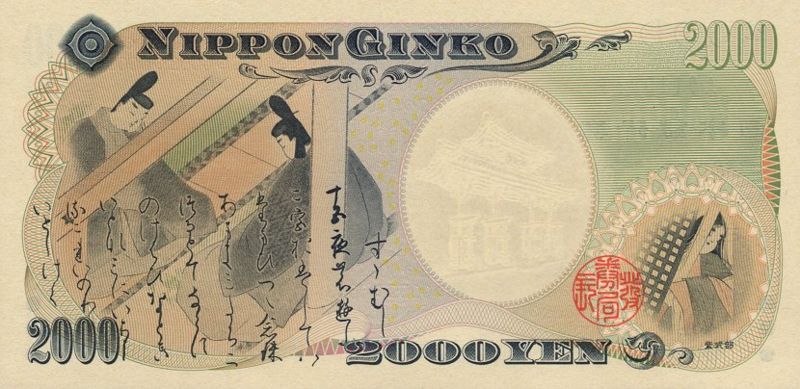
2000 Yen Note with Murasaki Shikibu
Many readers of this book are going to be disappointed in the fact that the plot is pretty sparse given the length of the work.  There is no doubt that it could have used a strong editor, but in ancient works it’s hard to fault authors for the lack of editing.  We’re really not sure if Murasaki Shikibu wrote the entire work or there were various authors that contributed.  According to Wikipedia:
Yosano Akiko, the first author to make a modern translation of the Genji, believed that Murasaki Shikibu had only written chapters 1 to 33, and that chapters 35 to 54 were written by her daughter Daini no Sanmi. Other scholars have also doubted the authorship of chapters 42 to 54 (particularly 44, which contains rare examples of continuity mistakes).

According to Royall Tyler's introduction to his English translation of the work, recent computer analysis has turned up "statistically significant" discrepancies of style between chapters 45–54 and the rest, and also among the early chapters.

There is also a lot of discussion on when Shikibu wrote this work – which leads to contrary opinions on if the character Murasaki is based on the author herself (alluded to above).

Since this book is written to chronicle normal lifestyle events of the upper class Japanese, the reader is able to learn quite a bit about a time period that would otherwise be unknown to us (~11th century Japan).  We’re able to learn about much about ancient Japanese culture including fine art, music, marriage customs, festivals and celebrations, communication methodologies, living arrangements, courting and poetry.

There are many two line poems in this work, involving nature/the seasons, music, love, tears (I call this one out separately because it is very prevalent), etc.  Poems, especially those between a man courting a woman, are written on various shades of coloured paper, all of which have different meanings.  Some notes are attached to plum tree, wisteria, or cherry blossom branches, etc.  The poems and the hand in which the notes are written, both tell a lot about the education and character of the writer which is essential when you cannot see the person you are pursuing (of course, all men in this society do all in their power to get a glimpse of a woman prior to courtship).  Most women live within inner chambers and are not visible to anyone other than their servants.    

Characters in the work, as mentioned above, are often alluded to by the places by which they’re from or titles that they possess.  The locations of their origin seem to stick with characters throughout the work.  However, if there are multiple main characters from the place then it sometimes gets confusing when differentiating between “the Akashi lady”, “the Akashi nun” and “the Akashi princess.”  When a character is named after a title such as the “Minister of the Right”, the character may eventually lose the title and therefore you have to remember that the next “Minister of the Right” is someone different altogether.  Also, many times princesses are referred to as the “first princess” or the “second princess” in birth order, but there may be multiple second princesses since there are multiple emperors.  In short, it’s hard to keep track of characters sometimes even with a strong translator who puts emphasis on character names.  I would not advise putting down the book for two weeks without reading it, as you’d lose some of the continuity in the story or recognition of character names.

Most of the characters I couldn’t relate to.  Genji was overdramatic and promiscuous and it was really hard to get behind him.  I did fall in love with Murasaki.  She continued to grow as a person, and while she never accepted Genji’s promiscuous ways she learned to make the best of a bad situation and was still able to love him and be a strong individual personality amidst a collectivist regime.  Kaoru was also one of the most noble characters and he always tried to live life with a strong moral integrity, despite his actions working against him in many ways.  He was one of the only characters that held firm to love so strongly that you could not consider it a passing infatuation.  He didn’t appear to be built to live without love.

‘The Tale of Genji’ was not an easy read.  The prose was very manageable, but the length of the work, the reoccurrence of many of the same plot elements over time and the lack of relatable characters made it a novel where you really had to focus and put effort into reading it.  That said, I find myself upset that the tale is over and no longer a part of my life.  I’m itching for an ending that will most likely never be known.  I’m glad I persevered through this (only one other in my book club finished), and the more I think about the novel the more I’m glad that I allowed myself to experience it.